


iPhone 14 Pro vs 13 Pro: Hardware and Feature Breakdown
- easy Phones
- Dec 10
- 4 min read

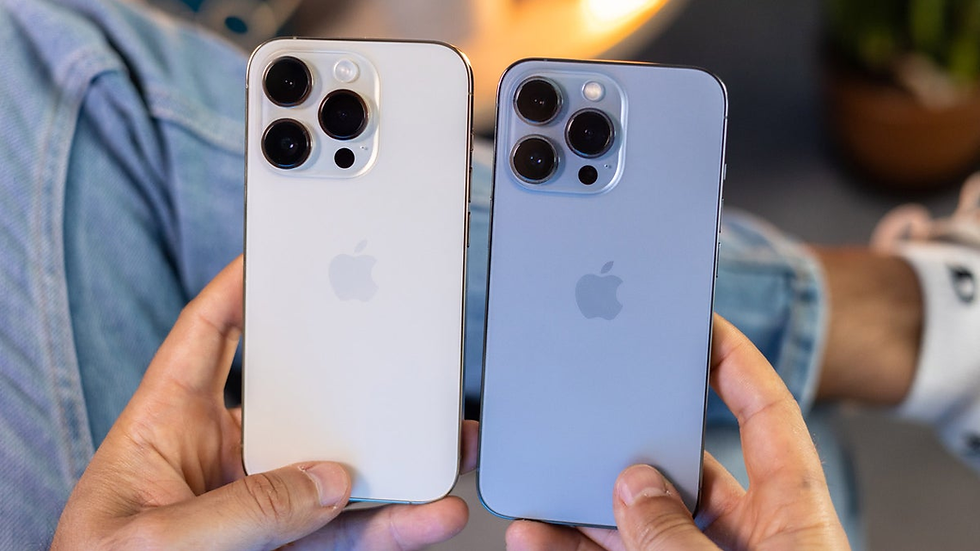
At first glance, the iPhone 14 Pro and iPhone 13 Pro appear similar, sharing Apple’s premium stainless-steel frame, ceramic shield glass, and nearly identical dimensions. The most visible exterior change on the 14 Pro is the replacement of the traditional notch with the Dynamic Island. This adaptive interface element blends software into the front camera cutout, introducing live activity widgets, navigation cues, and background task previews that modify the way users interact with notifications. By contrast, the 13 Pro retains the familiar notch without dynamic elements, which some users still prefer for its simpler visual layout.
Display quality remains a strong suit for both models. Each features a 6.1-inch Super Retina XDR OLED panel with ProMotion technology, offering refresh rates between 10Hz and 120Hz. The iPhone 14 Pro, however, boosts peak outdoor brightness to 2,000 nits—double that of the 13 Pro—making it noticeably easier to view under intense sunlight. The addition of an always-on display mode also sets the 14 Pro apart, allowing glanceable lock-screen information with minimal power consumption.
Performance and Software Experience
The iPhone 13 Pro runs on Apple’s A15 Bionic chip, which remains highly capable for modern apps, gaming, and image processing. Its 5-core GPU handles graphically demanding titles comfortably while maintaining stable frame rates. The iPhone 14 Pro advances to the A16 Bionic, built on a more efficient 4-nanometer process node. This shift provides marginal gains in raw CPU performance but, more importantly, improves sustained efficiency. In daily use, the A16 maintains consistent speeds during extended camera sessions and gaming without throttling as quickly under thermal stress.
Both phones ship with iOS support that remains long-term, but the newer hardware of the 14 Pro enables subtle enhancements to motion tracking, sensor processing, and imaging algorithms. In either case, users interested in deeper testing or customizations often look into how to turn on developer mode on your iphone to access diagnostic features and advanced debugging capabilities. While this option is identical across both models, the slightly higher processing headroom on the 14 Pro can make development tasks feel smoother.
Camera Systems and Imaging Capabilities
Camera upgrades represent one of the more significant differences. The iPhone 13 Pro features a 12MP triple-camera setup consisting of wide, ultrawide, and telephoto lenses. Its macro photography was considered industry-leading at launch, and low-light performance remains excellent with balanced detail and noise control.
The 14 Pro keeps the same lens architecture but dramatically upgrades the primary sensor to 48MP. This allows for 4x higher resolution when shooting ProRAW images and enables a new 24MP default output using pixel binning for enhanced detail and dynamic range. Portrait photography benefits from improved depth mapping without requiring a dedicated Portrait mode selection, streamlining casual photography. Video recording also sees gains with better stabilization and low-light capture through updated computational processing pipelines.
In everyday shooting scenarios, casual users may not notice dramatic differences under strong lighting conditions. However, those who crop images frequently or rely on RAW workflows will appreciate the extra clarity and editing flexibility of the 14 Pro.
Battery Life and Charging Efficiency
Battery longevity is one area where improvements may not be immediately obvious. Apple does not publish official battery capacity figures, but real-world testing shows both phones delivering similar endurance on mixed usage. The iPhone 13 Pro already performed reliably, lasting a full day of streaming, navigation, photography, and social browsing for most users.
The iPhone 14 Pro benefits from the efficiency gains of the A16 chip, helping offset increased display brightness and the always-on screen feature. In practice, endurance remains within a similar range to its predecessor, with some users observing slightly better standby efficiency during idle periods. Charging technology is unchanged between generations, retaining 20W wired fast charging and 15W MagSafe wireless charging. Neither offers revolutionary speed improvements, but consistency remains strong. Overnight wireless charging remains practical without concerns for excessive heat or long-term degradation because of Apple’s optimized charging controls.
Connectivity, Safety, and Sensor Enhancements
On the connectivity front, both models support 5G, Wi-Fi 6, ultra-wideband (UWB), and Bluetooth 5.3. The iPhone 14 Pro adds a second-generation UWB chip with improved range for more precise Find My tracking. Safety features also expand: Crash Detection and upgraded emergency satellite messaging distinguish the 14 Pro from its predecessor, offering additional peace of mind for travelers and drivers.
Sensor arrays on the 14 Pro receive refinements, contributing to more responsive auto-brightness adjustments and better motion detection for activities and gaming.
Longevity and Value Perspective
From a longevity standpoint, the iPhone 13 Pro continues to be a capable flagship with years of software support ahead, and many users seek options such as a refurbished apple iphone 13 pro as a sustainable approach to ownership. Similarly, those seeking the latest capabilities may consider a refurbished apple iphone 14 pro to balance innovation with cost efficiency. Both devices also fall under broader discussions about the quality and availability of refurbished apple iphones in india, which reflects growing awareness of circular tech consumption models offered by retailers like Easy Phones within the market ecosystem.
Final Thoughts on Hardware Evolution
When comparing the iPhone 14 Pro and iPhone 13 Pro, the changes are evolutionary rather than revolutionary. The new Dynamic Island interface, enhanced camera hardware, brighter display, and efficiency improvements give the 14 Pro a clear technical edge. However, for users prioritizing dependable performance, premium build quality, and strong cameras, the 13 Pro remains a robust and enduring option. Ultimately, the choice depends on whether the latest refinements justify the jump, or if the proven stability of the previous model already meets everyday needs.


Comments